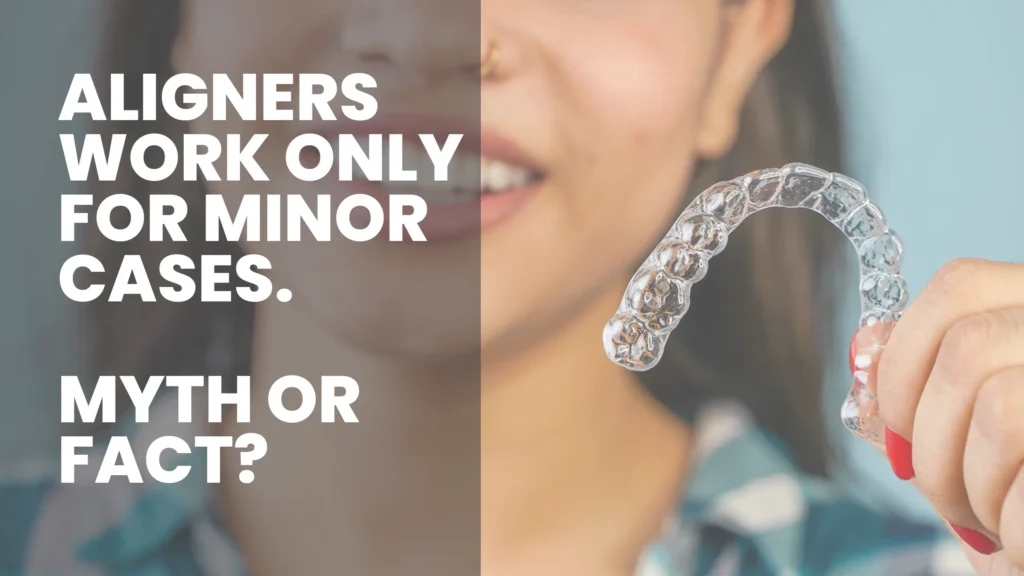
Clear aligners have transformed the way people approach orthodontic treatment, offering a more discreet and comfortable alternative to traditional braces. Today, they are widely used for correcting various alignment issues. However, when aligners were first introduced, they were primarily capable of handling only minor corrections and were not suitable for more complex orthodontic problems. This early limitation led to a common question that still exists today:
“Are aligners only suitable for minor alignment issues?”
Let’s take a closer look at the reality.
Table Of Content
The Short Answer: It’s a Myth (With Some Limitations)
The belief that aligners only work for minor cases is mostly a myth. Modern clear aligner systems are designed to treat mild, moderate, and even many complex orthodontic problems, depending on proper case selection and orthodontist expertise.
However, not every case is ideal for aligners. The suitability depends on the severity and type of misalignment.
What Problems Can Aligners Treat?
Clear aligners can effectively correct:
- Crowded teeth
- Gaps between teeth
- Mild to moderate overbite
- Underbite
- Crossbite
- Open bite (selected cases)
- Relapse after previous braces
With the help of advanced 3D digital treatment planning and precision attachments (small tooth colored bumps placed on teeth), aligners are now capable of achieving tooth movements that were previously possible only with conventional braces.
When Are Aligners Truly Effective?
Aligners work well when:
- The patient is consistent in wearing them 20 – 22 hours per day
- The case is properly diagnosed using digital scans and X-rays
- The treatment plan is designed by an experienced orthodontist
- The patient follows instructions regarding attachments
Modern aligner technology is designed to guide teeth through a range of controlled movements, including adjustments in position, angulation, and vertical alignment. While such movements were once thought to be achievable mainly with traditional braces, advancements in aligner systems have expanded their capabilities.
However, the predictability and success of these movements depend on individual case factors and proper treatment planning.
When Braces May Be a Better Option
In some complex cases, traditional braces may still be recommended, such as:
- Severe skeletal jaw discrepancies
- Very complex bite correction cases
- Impacted teeth
- Cases requiring significant vertical corrections
- Patients who may not comply with aligner wear
Orthodontic treatment is highly individualized. The most appropriate approach is determined after a thorough clinical evaluation and diagnosis tailored to each patient’s specific needs.
Why the “Minor Cases Only” Myth Started
Early generation aligners were limited in their ability to move teeth predictably. At that time, they were mainly recommended for simple cosmetic corrections.
But with advancements in:
- SmartTrack materials
- AI based treatment simulation
- Precision attachments
- Interproximal reduction (IPR) techniques
Clear aligners have evolved significantly.
What Research and Clinical Experience Show
Multiple clinical studies and orthodontic practices worldwide confirm that aligners are effective for a wide range of cases when properly planned.
Today, many orthodontists successfully treat moderate crowding and bite issues using aligners, sometimes combined with elastics or attachments for better control.
The Real Answer: Case Selection Matters
So, are aligners only for minor cases?
No – but they are not for everyone.
The decision depends on:
- Severity of misalignment
- Jaw relationship
- Age of the patient
- Compliance level
- Orthodontist’s evaluation
A proper clinical consultation is essential before deciding.
Thinking About Clear Aligners?
If you’re exploring clear aligner treatment and want to know whether your case is mild or complex, book a consultation with a certified orthodontist. The right diagnosis can help you choose the best treatment for a confident, healthy smile.
Still unsure whether aligners or braces are the right choice for you? Explore our comprehensive guide at Clear Aligner in Kerala to understand the differences, benefits, and what to expect from each treatment option.